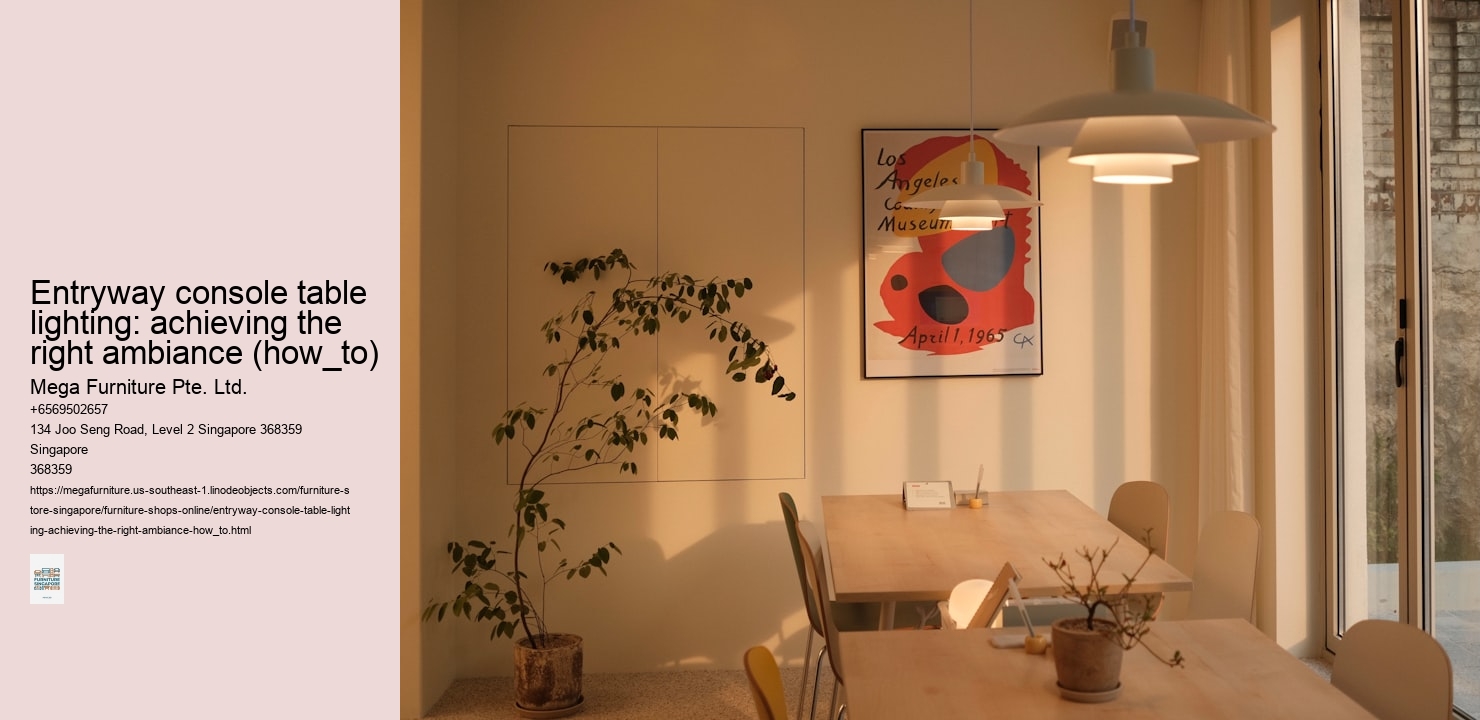
HDB corridor lights often get chosen for durability over style — a practical decision when you're working with 1.2 metres of width and neighbours' bicycles parked half in the walkway. Condo foyers might offer more breathing room at 2–3 sqm, but humidity still dictates the rules: IP44-rated fixtures aren't negotiable unless you enjoy scrubbing corrosion off brass finishes every quarter.
Floating sofas in open-plan layouts create their own lighting headaches. That 30cm clearance behind the backrest? Just enough space for a table lamp base, but only if you've measured twice — most console tables clock in at 25–40cm deep, leaving barely any margin for error. The best solutions here tend to be wall-mounted swing arms or plug-in sconces; anything freestanding risks becoming a hip-bruising hazard in tight quarters.
Console tables in entryways pull double duty as catch-alls for keys and display surfaces for decor, which means their lighting can't be an afterthought. At 75–90cm tall, they're low enough that overhead fixtures often cast shadows right where you need task lighting most. A pair of 20W LED picture lights mounted above, or a single ceramic table lamp with a linen drum shade, typically strikes the right balance between ambient glow and practical illumination for rummaging through drawers.
Singapore's particular brand of space constraints turn every lighting choice into a compromise. That slim console table might fit perfectly in your HDB hallway, but its shallow depth means standard lampshades will jut into the walkway — go for oval or rectangular silhouettes instead, or better yet, wall lights with a 15cm projection. A console table sits in the awkward gap between bookshelf and side table — narrow enough to push against a wall or behind a sofa, tall enough to function as an entryway drop zone or hallway accent. Megafurniture's Console Table range covers narrow accent tables in wood, metal, marble, and sintered stone tops, with heights from 50cm side table format up to 75cm hallway console proportions. Most include either an open shelf or small drawer for keys, mail, and entryway clutter.. Humidity-resistant finishes matter less here than in bathrooms, but skip fabric cords unless you enjoy the look of mildew speckles.
Rubberwood consoles with open shelving solve one problem (storage) while creating another (cord management). The cleanest installs route wiring through pre-drilled channels in the back panel, though that requires committing to a permanent position — not ideal for serial rearrangers. Plug-in options offer flexibility, but then you're stuck disguising power strips behind woven baskets or decorative boxes.
Singapore’s 80% humidity warps wood veneers within months, leaving behind peeling edges and cloudy finishes. Powder-coated metals hold up better—look for matte finishes that disguise inevitable micro-scratches from daily use. Megafurniture’s tempered glass table lamps handle condensation without fogging, though you’ll still need to wipe down the bases weekly during monsoon season.
UL Wet Location ratings matter more than aesthetics for cords near entryways. That sleek rattan-wrapped cable won’t last through one December downpour; opt for thick, rubberised sheathing instead. Most buyers overlook this until their third replacement—check the certification near the plug, not just the product description.
Console tables against exterior walls face the worst moisture exposure. Avoid MDF cores entirely—even with sealing, the edges swell where humidity seeps through screw holes. Stainless steel legs with sealed concrete tops work for landed homes, but HDB corridors need lighter solutions like vacuum-sealed bamboo.
The real test comes when guests drip wet umbrellas against your console. Powder coating prevents rust, but water pools under decorative trays—integrated drainage channels or a slight forward tilt solve this. For high-traffic areas, skip woven materials entirely; they’ll start smelling of mildew by the third rainy season.
Megafurniture’s side tables use anodised aluminium legs that resist salt air near coastal neighbourhoods like Marine Parade. Just don’t pair them with untreated leather storage baskets—those belong in air-conditioned bedrooms, not humid entryways.
Angle lights to accentuate artwork, mirrors, or decor atop the console. LED strip lights underneath the table can create a floating effect. Keep wiring discreet with cord covers or wireless options.
Combine ambient lighting (overhead) with task lighting (focused on the table) for depth. Use dimmers to adjust brightness for different times of day. Avoid harsh shadows by positioning lights at eye level or slightly above.
Opt for wall-mounted sconces or a slim-profile table lamp to save space while illuminating your entryway console. Consider warm white bulbs (2700K-3000K) for a welcoming glow. Ensure fixtures complement the table’s style—modern, rustic, or minimalist.
Console tables under 35cm depth leave minimal space for lighting bases—anything over 20cm protrudes awkwardly into walkways. Slim-profile sconces with flush mounts work best, particularly in HDB corridors where every centimetre counts. Swing-arm designs allow temporary extension when needed, then tuck back against walls. Consider LED panels or recessed lighting for ultra-narrow surfaces below 25cm depth. The goal is illumination without sacrificing precious hallway width.
Narrow surfaces demand precise light distribution—wide beams wash out walls while tight spots create harsh pools. For 30-40cm deep consoles, 60° adjustable heads provide flexibility between task and ambient lighting. Test placements at 1.8m height to avoid glare in low-ceilinged flats. Warm whites (2700-3000K) prevent clinical feels in compact entryways. Dimmable options accommodate both midnight key searches and daytime decor highlights.
Brushed nickel or matte black fixtures complement most contemporary console finishes without competing visually. Avoid glossy metals in high-traffic areas where fingerprints accumulate. For wood-grain consoles, match warmths—cool-toned lighting clashes with teak or walnut undertones. In white minimalist schemes, consider clear glass globes to maintain airiness. The right pairing makes fixtures disappear into the background while still performing.
Hallway sconces need accessible controls—no one wants to navigate past console decor to flip switches. Motion sensors work well for shoe storage zones but disrupt movie nights. Smart bulbs solve this with phone controls, though older relatives may prefer physical rocker switches. Position controls 1.2m up the wall for universal access. Always confirm wiring paths before drilling into HDB concrete walls.
Dust collects fastest on upward-facing sconce shades—a real issue above console displays. Opt for downward-facing or fully enclosed designs near open shelving. LED units last longer but require complete replacement when faulty. Keep spare bulbs in console drawers for quick swaps. Remember: cleaning compact spaces means negotiating around table decor, so choose wipeable materials over delicate fabrics.
Walk into any 12 sqm HDB bedroom and you’ll spot the same oversight—a floor lamp wedged between bed and wardrobe, eating up precious walking space. That’s 30cm of corridor width lost to a base that could’ve been wall-mounted instead. Singaporeans fixate on floor plans but forget vertical real estate exists; in narrow hallways, even a slim console table demands sconces or pendant lights that hover above eye level.
The warm white versus cool white clash is another rookie error. Buyers test 2700K bulbs at home, then realise too late how jaundiced they look against HDB corridor lighting’s clinical 4000K. It’s an expensive lesson—those bulbs can’t be returned once unboxed. Smarter shoppers trial 3000K first; close enough to feel cosy indoors without fighting the building’s infrastructure.
Console tables suffer particularly from poor lighting choices. A 25cm-deep surface in an 80cm-wide hallway leaves no room for table lamps—yet you’ll still see them perched precariously, cords snaking across the only walkway. Wall-mounted fixtures solve this, but require early planning; most buyers realise the need only after drilling holes for the console and regretting their lack of foresight.
There’s a stubborn belief that more light equals better light. In reality, a single well-placed 5W LED spotlight above a console table does more for ambiance than three mismatched lamps fighting for attention. The trick is treating the console as part of the room’s lighting circuit—not an afterthought.
Megafurniture’s Joo Seng showroom demonstrates this well, with narrow console setups lit entirely by overhead tracks. Their displays prove you don’t need floor space to create layers of light—just the discipline to stop treating walls as blank canvases.
The Joo Seng showroom’s lighting displays solve a common Singaporean dilemma—how to balance console table aesthetics with smart home functionality. Fifteen lighting combos sit atop actual console tables, not mock-ups, so you see exactly how that brass swing-arm lamp casts shadows across your entryway’s feature wall. Staff demonstrate dimmer compatibility with StarHub SmartHome systems, crucial for landed property owners automating entire floors. Console tables in narrow HDB hallways often become dead zones after sunset. Megafurniture’s live setups show how uplighting bounces off matte ceilings (better for 2.4m HDB heights) versus directional spots that carve visual corridors in open-plan condos. They’ll plug your phone into the demo circuit so you can adjust Kelvin temperatures—proving that 2700K warms dark walnut veneers better than the 3000K most contractors default to. The Somnuz® mattress section’s blackout curtains create a rare opportunity to test glare control. Those crystal table lamps that look garish under showroom fluorescents? Under controlled lighting, their cut-glass patterns throw intricate shadows that elevate even mass-market console designs. For serious buyers, the staff will dim the entire showroom to simulate a 4-room BTO’s evening ambiance. That’s when you notice how LED strips hidden behind floating consoles (a signature of their
storage-integrated designs) make narrow spaces feel wider. No renderings or brochures can replicate seeing your phone’s midnight blue case reflecting in a polished nickel base at actual 1:1 scale. Landscape lighting transfers poorly to console tables—what works for a Gardenia-lined semi-D driveway overwhelms a 35cm-deep hallway piece. The showroom’s side-by-side comparisons save you from buying fixtures that’ll end up relegated to the bomb shelter.
In Singapore, plugging in a new table lamp isn’t as straightforward as it seems. Hardwired fixtures, often found in ceiling lights or wall sconces, require installation by a licensed electrician — a regulation that catches many homeowners off guard. For imported lamps, CSA certification is mandatory, ensuring they meet local electrical safety standards. Some sellers skip this step, leaving buyers with non-compliant products that could fail inspection or, worse, pose a fire hazard.
Table lamps, especially those paired with console tables, are a popular choice for entryways and behind-sofa setups. Their plug-and-play design makes them seem hassle-free, but imported models often come with foreign plugs. Megafurniture includes free CSA-certified plug conversion for its imported lamps, ensuring they’re ready to use straight out of the box. This service isn’t just a convenience; it’s a necessity for compliance and safety.
Delivery plays a significant role in electrical safety too. A poorly packed lamp can arrive with damaged wiring or cracked sockets, issues that aren’t always immediately visible. Opting for retailers with careful packaging and reliable delivery services reduces the risk of receiving a faulty product. It’s worth noting that some budget options skimp here, prioritising low cost over secure transit.
For condo and landed homeowners, electrical safety is non-negotiable. A non-compliant lamp might seem like a minor issue, but it can lead to costly repairs or even void insurance claims. In many HDB flats, where space is tight and furniture placement is precise, ensuring your lamps are both functional and safe is a small but crucial detail.
Can I use balcony lights indoors? No—balcony lights are designed for outdoor conditions and typically have higher IP ratings to withstand rain and humidity. Using them indoors can lead to overheating or premature failure, especially in enclosed spaces like HDB bathrooms or kitchens. Stick to indoor-rated fixtures for safety and longevity.
Best bulb for 1970s HDB wiring? LED bulbs under 12W are the safest bet for older wiring systems. They draw less power, reducing the risk of circuit overload, and still provide ample brightness for most spaces. Avoid high-wattage bulbs, as they can strain outdated electrical systems—something many HDB homeowners overlook until the breaker trips.
How to light a 4m narrow hallway? Three staggered sconces spaced at 1.5m intervals create balanced illumination without overwhelming the space. Wall-mounted fixtures keep the floor clear, which is crucial in tight hallways where every centimetre counts. Opt for warm-toned LEDs to soften the light and avoid that clinical, hospital-like feel.
Storage beds beat divan beds in most HDB flats, simply because nobody has anywhere else to put their luggage. The same logic applies to lighting—choose fixtures that multitask, like sconces with built-in shelves or LED strips that double as accent lighting.
Most homeowners don’t realise that lighting can make or break a narrow hallway. Too bright, and it feels like a tunnel; too dim, and it becomes a hazard. The trick is layering—ambient light from sconces, complemented by a subtle overhead fixture if ceiling height allows.
Before plugging in that new console table lamp, run a tape measure along the wall depth—most HDB corridors max out at 40cm, leaving zero wiggle room for cords snaking behind narrow profiles. Humidity ratings matter more than you’d think; that rattan shade from the pop-up market will warp within months in Bedok’s coastal air unless it’s labelled for 70% RH or higher. Left-handed users get forgotten in lighting design—test switch placement with your off-hand while holding a grocery bag, because nobody wants to fumble for controls when their arms are full of FairPrice packets.
Megafurniture’s app solves the guesswork for condo dwellers—snap a photo of your entryway, and their AR overlay shows how a 45cm-wide lamp base crowds the shoe rack versus a slim 25cm profile. Their Joo Seng showroom even lets you test glare angles under simulated evening lighting (most buyers don’t realise how much their polished marble floors bounce light until it’s installed).
Three non-negotiables for open-plan layouts: dimmable bulbs (those west-facing windows flood Tampines units with golden hour glare), warm whites under 3000K (cool lighting turns your taupe feature wall grey), and at least one outlet within 1.5m of the console—extension cords ruin the minimalist look. Pro tip: tape newspaper cutouts to the wall first to visualise proportions; a 60cm-wide lamp swallows up narrow BTO hallways but disappears in landed property foyers.
For humidity-prone ground floors near Eunos MRT, skip fabric cords and go for braided rubber—it won’t mildew when the monsoon seeps under the door. And if you’re pairing lamps with mirrored consoles, angle the shades downward unless you enjoy being blinded by reflected ceiling lights at 3am.